In “Together”, Alison Brie and Dave Franco Get Under Each Other’s Skin – And It’s Pretty Creepy | Review
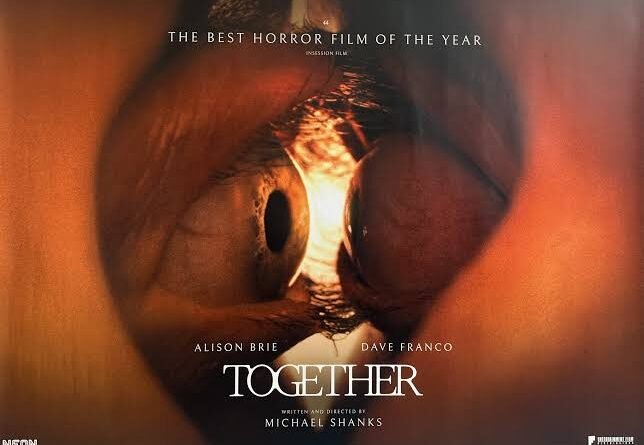
Sometimes, a movie poster is better than the movie itself. When I first saw the posters for “Together”, I wondered whether this might be one of those cases. After all, what could be creepier than Alison Brie and Dave Franco – who, as we all know, are also a real-life married couple – kissing with their lips seemingly fused together? Or an image of their eyes connecting as if they were having sex (or, more accurately, eye sex)?
The poster made it easy to assume we were dealing with a body horror movie, a genre that has enjoyed a revival in recent years. Then came the positive reviews, which raised my expectations even further. After watching “Together”, I can confidently say that this is a refreshing horror film, built around an intriguing concept, with excellent performances and several genuinely creepy moments. On the other hand, I felt the movie could have gone much further in several areas, including the grotesque imagery and the horror sequences themselves. The body horror here is less extreme than what we’ve seen in other films that explore the destruction and transformation of the human body.
So, is “Together” a romantic comedy with a horrifying twist, or a body horror film that will make you think twice before kissing your partner, hugging them, or even getting too comfortable in the spooning position? Stay close to our “Together” review and decide for yourself.
The Plot of “Together”: When a Relationship Gets Too Sticky
In “Together”, Michal Shanks ‘ feature-length directorial debut, Brie and Franco play Millie and Tim, respectively. Millie is a teacher who wants to move to a new school in a rural area, hoping for a fresh start. Tim is a musician who hasn’t quite found his direction and feels he’s gradually losing himself in the relationship, pushing him even further from his dream of building a music career.
After a farewell party takes an unfortunate turn, the couple arrive at their new home and discover a few secrets that wouldn’t look out of place in a horror movie, including rats in a light fixture. But the more important events take place shortly afterward, when they go for a walk in the forest surrounding their house. They encounter some bells, fall into a creepy cave that seems to have a history of its own, and discover that drinking water from an unknown source is generally a terrible idea.
As you may have guessed from the poster, the trailer, and this general description, the couple soon discover that separating is becoming extremely difficult – quite literally, rather than merely emotionally. It begins with a few minor incidents in which their bodies unexpectedly connect, but things become increasingly serious as the movie progresses.
We follow the couple, particularly one of them who gradually realizes that something very strange is happening beneath the surface, as they try to understand why even a kiss – let alone a sexual encounter in the bathroom – can suddenly become a potentially life-threatening situation.
Along the way, we get several jump scares and moments of tension, some effective and others rather unnecessary. As time goes on, the physical imagery becomes increasingly disturbing, as you’d expect from a body horror film. Some of it is genuinely unsettling, but it never quite reaches the stomach-churning levels of other movies we’ve seen over the past few decades, including the magnificent “The Substance”.
Shanks clearly draws inspiration from other works in the body horror genre, particularly some of its earlier classics, but struggles to take those influences one step further. There aren’t many images here you haven’t seen in other body horror films, or even in slashers that blur genre boundaries. Think, for example, of the bloody killing sprees of Art the Clown in the “Terrifier” movies.
Original horror apparel, posters, stickers & home décor.
New horror designs are added regularly.
Together in Real Life, Too
“Together” is the feature-length directorial debut of Michael Shanks, following his 2019 short film “Rebooted” and the web comedy series “The Wizard of Aus”, which he created several years earlier. What is relevant to our story is that Shanks -who also wrote the screenplay – has been in a relationship since the age of 18. It is a long-term relationship, one that some might describe as “clingy.” A relationship that lasts for years can become so close, so intertwined, that the two people involved may start to feel like a single entity. And that, of course, is fertile ground for a body horror movie about the physical – and, to some extent, psychological – transformations that can take place within a relationship.
Alison Brie (“Mad Men”, “Community” and “GLOW” on television, as well as “Sleeping with Other People”, “The Little Hours” and “Scream 4” on the big screen) and Dave Franco (“Now You See Me”, “Neighbors” and “The Disaster Artist”) have been married since 2015. They’ve worked together on several projects, including the enjoyable thriller “The Rental” and the romantic comedy “Somebody I Used to Know”, which was directed by Franco himself. Their casting as the married couple at the center of “Together” therefore feels like a natural choice, especially since the two also serve as producers of the film.
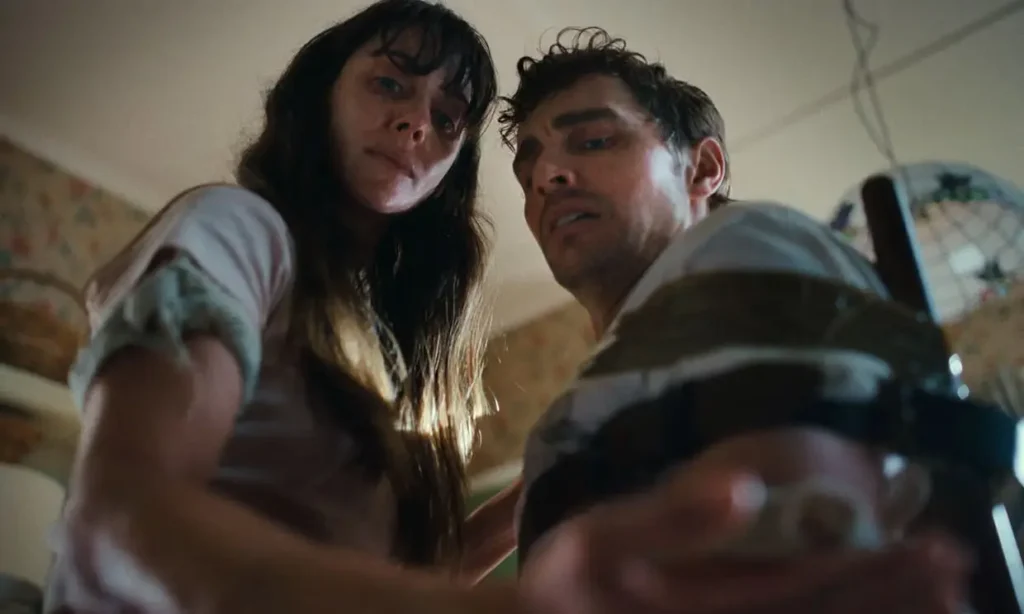
Although Brie and Franco weren’t officially involved in writing the screenplay, a few details invite comparisons to their own relationship. For example, the couple in the film has been together for about a decade but is still unsure about marriage and certainly isn’t ready to have children. In real life, Brie and Franco have said that they don’t want children.
It’s tempting to read the film as an exploration of the anxieties that can emerge from spending many years with one partner, particularly within a monogamous relationship. Perhaps those concerns belong more to the screenwriter than to the two stars themselves, at least judging by the interviews they’ve given about their very public relationship.
There is also a legal controversy surrounding the film. According to a lawsuit filed by production company StudioFest, the creators of “Together” allegedly borrowed substantial elements from a screenplay titled “Better Half”, which had previously been submitted to the agents representing Brie and Franco. The plaintiff claims the earlier script shared a remarkably similar premise: a couple whose bodies become physically fused as a metaphor for codependency. The defendants have disputed the allegations, and the case has continued through the courts. A judge declined to dismiss the lawsuit early in February 2026, but that decision should not be mistaken for a finding that the film was copied. Either way, the controversy adds another unusual layer to a movie that is already about couples becoming a little too attached.

Body Horror With a Relationship Twist
“Together” introduces several issues connected to the characters’ pasts, particularly Tim, who experienced trauma involving his parents. Unfortunately, apart from a fairly frightening scene near the beginning, this aspect of his character isn’t developed sufficiently. The film also doesn’t spend much time questioning the origins of the bizarre process the characters are going through. In another context, viewers might wonder whether it could be related to their complicated mental states, past trauma, medication, or something else entirely.
The opening scene featuring dogs, along with a few hints scattered throughout the movie, makes it fairly clear quite early on why the transformation is happening. The film explores the origins of the phenomenon and connects it to another character’s past, but I can’t say these questions kept me awake at night. Does it really matter whether the source is a secret cult, a medical experiment gone wrong, a psychopath conducting grotesque experiments (think “The Human Centipede”, since we’re already discussing the idea of physically connecting people), an alien spacecraft that landed in the middle of a forgotten town, or something else altogether?
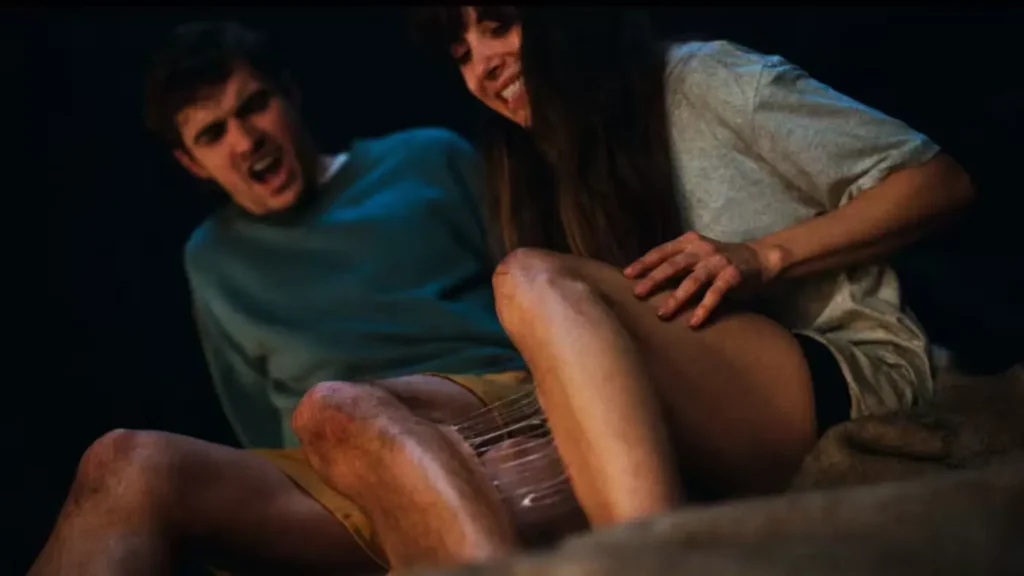
The movie does try to explore some deeper ideas, with varying degrees of success. Without giving too much away, one of the dialogues refers to Plato’s philosophical work “The Symposium”, specifically the speech by Aristophanes about the nature of love.
Without getting too philosophical, the idea is that humans were once spherical beings with four legs, four arms, two heads, four eyes, and various other doubled body parts. In other words, they were essentially two people joined together. Zeus feared that these powerful creatures might rival the gods, so he split them in two. Ever since, each person has been searching for their other half.
“Together” takes this ancient idea and makes it much more literal. It also raises questions about religion, sexuality, and modern relationships. There’s even an interesting gender dynamic involving a woman who is pursuing her own ambitions while the man remains stuck behind, depressed and frustrated by a career that refuses to take off.
The Message of “Together”: Is Being Single the Safer Option?
It’s impossible to ignore the fact that the filmmakers chose body horror for a reason. In this genre, extreme physical transformations or the invasion of the human body by external objects often symbolize a deeper threat: the blurring of boundaries between our bodies and something else.
Different body horror films explore different kinds of threats, sometimes in a deliberately critical way. They can relate to scientific exploration and humanity’s curiosity about the universe, as in “Alien” and “The Thing”; technologies that threaten to take control of our lives, as in David Cronenberg’s “Videodrome”; gender differences and the way men and women perceive one another, as in the disappointing “Men”; or our obsession with eternal youth and an idealized version of ourselves, as in the masterpiece “The Substance”.
In the case of “Together”, the threat comes from the relationship between two partners. Their connection becomes stickier than in any romantic comedy, quite literally.
It’s difficult to describe “Together” as a romantic comedy, even though it includes a few amusing moments (some more successful than others), a love story, and even a couple of brief nude scenes. The filmmakers rely more heavily on practical effects than on computer-generated imagery, although both are used throughout the film in considerable quantities. The result is convincing for the most part, and the physical transformations are among its strongest elements.
There have also been reports that Brie and Franco spent hours physically connected during filming, taking their on-screen relationship several steps further. Whether this was a test of their chemistry or simply of their patience, it certainly sounds like an unusual way to spend a workday.
The good news for Brie and Franco is that the film demonstrates that they have excellent chemistry on screen – or, more accurately, that they once had excellent chemistry, because the movie presents a relationship in crisis that affects almost every aspect of their lives. Unlike other films centered on a couple, particularly a married one, the two actors don’t lose their presence when they’re alone in the frame or sharing a scene with one of the few supporting characters.
Franco is particularly impressive. His role is demanding and requires a delicate balance: he has to portray a man gradually losing control without turning him into a complete caricature of a person going insane – you know, someone who moves like a zombie that accidentally ate a hallucinogenic mushroom covered in poisonous ants that had been drinking alcohol while pregnant.
Both Brie and Franco demonstrate their comedic, dramatic, and occasionally creepy abilities. Neither delivers a performance that will necessarily be remembered for years, but they are convincing enough to carry the film. Still, it’s difficult to stop thinking of them as Alison Brie and Dave Franco rather than Millie and Tim. Whether that’s because we already know they’re a real-life couple or because of a weakness in the screenplay, this familiarity takes something away from the film’s impact.
The movie doesn’t do enough to make its characters particularly sympathetic or to draw us deeply into their relationship. As a result, I found myself watching the horrors they experience and the collapse of their marriage with a somewhat detached attitude. I understood what the film was trying to achieve, but I wasn’t always emotionally invested in the outcome.
When Cinematography Meets the Spice Girls
The film tries to present its theoretical ideas as a mystery, even if some of the answers become obvious fairly quickly or are explained a little too explicitly. Michael Shanks gradually and intelligently portrays the couple’s transformation, both through the screenplay – including the dialogue and a brief early scene in which the two almost dress identically – and through the visual storytelling, which is genuinely impressive at times.
Shanks connects different but visually similar actions performed by the couple to suggest their bond, a connection that will eventually become physical. It’s a clever approach, although I didn’t always understand the rules governing this strange connection. That uncertainty helped make some of the encounters between the characters more surprising, but it also made the threat they were facing a little harder to follow.
On the negative side, some aspects of the filmmaking, particularly the cinematography, felt a little too conventional. The film could have pushed its visual boundaries further, creating more imaginative shots to match the bizarre images unfolding on screen. Some scenes are also perhaps a little too dark, while the soundtrack is effective but occasionally predictable.
And then there’s the music. Before I even watched the movie, I tried to imagine which song I might associate with it in a future social media post. One particular Spice Girls song immediately came to mind. We won’t reveal which one, although it’s fairly obvious once you think about the film’s central idea.
The filmmakers made an excellent choice by incorporating that song into the story itself, rather than simply using it as a background track. It appears during one of the movie’s key moments, and the result is genuinely amusing. In fact, it’s one of the more effective and entertaining uses of a Spice Girls song in cinema – certainly in horror cinema. Who am I to complain?
Should You Watch “Together”?
Ultimately, “Together” isn’t a movie that tries to be too sticky. It’s well made, occasionally frightening, and features excellent chemistry between its two leads (like, duh). It also says something about relationships in the modern world, even if it doesn’t always explore those ideas as deeply as it could.
I wouldn’t call it groundbreaking enough to be a masterpiece, and I think it could have pushed its body-horror elements further. Still, it’s a refreshing and entertaining film with a strong central concept, impressive practical effects, and two actors who clearly aren’t afraid to put themselves through some rather uncomfortable situations.
“Together” may not be the most extreme body horror movie you’ll ever see, but it’s certainly one of the more memorable horror films of 2025. And after watching it, you might find yourself reconsidering just how close you really want to be to your other half.
“Together” (2025) – Frequently Asked Questions
Who directed “Together”?
“Together” was written and directed by Australian filmmaker Michael Shanks. It marks his feature-length directorial debut.
Who stars in “Together”?
The film stars Alison Brie as Millie and Dave Franco as Tim. The supporting cast includes Damon Herriman as Jamie, Mia Morrissey as Cath, and Karl Richmond as Jordy.
Are Alison Brie and Dave Franco married in real life?
Yes. Alison Brie and Dave Franco are married in real life. They tied the knot in 2015 and have worked together on several projects, including “The Rental” and “Somebody I Used to Know”. Their real-life relationship adds an extra layer of interest to their performances as a couple whose relationship takes a horrifying physical turn.
What is “Together” about?
“Together” follows Millie and Tim, a long-term couple who move to the countryside in an attempt to start a new chapter in their relationship. After exploring a mysterious cave and drinking water from an unusual source, they begin experiencing a disturbing physical connection that makes it increasingly difficult — and sometimes dangerous — to be apart.
Is “Together” a body horror movie?
Yes. “Together” is primarily a body horror film, although it also incorporates elements of supernatural horror, dark comedy, and relationship drama. Its central premise uses physical transformation as a metaphor for codependency and the blurred boundaries between two people in a long-term relationship.
How long is “Together”?
The running time of “Together” is approximately 102 minutes (1 hour and 42 minutes).
When was “Together” released?
“Together” premiered at the Sundance Film Festival in January 2025 before receiving its wide theatrical release in the United States on July 30, 2025.
What Do Critics and Audiences Think of “Together”?
“Together” received a largely positive response from professional critics. On Rotten Tomatoes, the film holds an 89% Tomatometer score, based on 246 critic reviews, with an average rating of 7.2/10. Its Metascore on Metacritic is 75 out of 100, indicating generally favorable reviews. Critics have particularly praised the film’s inventive approach to body horror, its unsettling practical effects, and the chemistry between Alison Brie and Dave Franco. Some reviewers, however, felt that the film’s central ideas could have been explored in greater depth.
Audience scores are somewhat more mixed, though still generally positive. “Together” has a 75% Popcornmeter score on Rotten Tomatoes, while its IMDb rating stands at 6.7/10, based on more than 90,000 user votes. On Metacritic, its user score is 6.6/10. Overall, viewers seem to appreciate the film’s disturbing imagery, unusual premise, and the performances of its two leads, even if not everyone was equally impressed by its story or execution.
How Much Did “Together” Make at the Box Office?
“Together” grossed approximately $34.7 million worldwide during its theatrical run. This includes around $21.3 million in the United States and Canada and approximately $13.5 million from international markets. The film opened in the US with a little over $6.7 million and went on to become a solid box-office performer for an original body horror film.
What is the MPAA rating of “Together”?
“Together” is rated R by the Motion Picture Association (MPA) for graphic nudity, brief drug content, language, sexual content, and violent and disturbing material. It is intended for mature audiences.
Is “Together” based on a true story?
No. “Together” is a work of fiction. However, its exploration of long-term relationships, codependency, and the fear of losing one’s individual identity draws on recognizable relationship dynamics. The film’s writer-director, Michael Shanks, has discussed the personal and philosophical ideas behind its central concept.