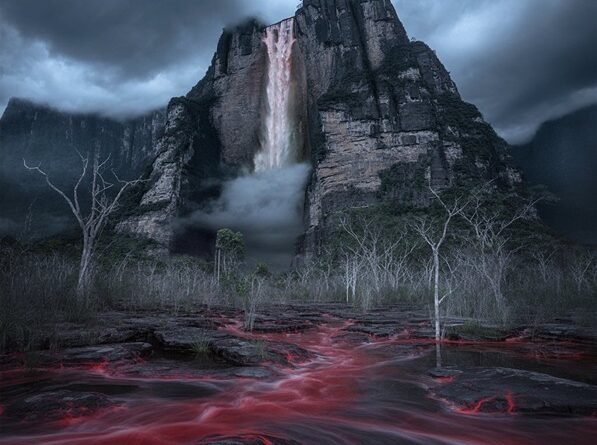
Angel Falls in Venezuela: The World’s Tallest Waterfall – But How Dangerous Is It?
Deep in the jungle of southeastern Venezuela, in a region that seems almost untouched by time, lies one of the most spectacular and intimidating natural wonders on Earth. Angel Falls is famous for its extraordinary height, its remote location, and the sense of danger that surrounds the journey to reach it. Here, breathtaking beauty and a primitive sense of fear exist side by side.
The waterfall is 979 meters (3,212 feet) tall, including an uninterrupted drop of approximately 807 meters (2,648 feet). That is an almost unbelievable distance for water to plunge through the air, creating a spectacle that inspires both awe and vertigo.
As part of our coverage of scary natural attractions, we know that waterfalls can have a surprisingly frightening side. With Angel Falls, however, it is not just the sheer scale that makes it intimidating. The surrounding wilderness reminds us how small we are compared with the forces of nature, and how many places on our planet remain difficult for humans to reach.
The enormous height, the mist-filled plunge, the isolation, and the challenging journey through the Venezuelan jungle all contribute to its reputation. This is not an attraction you simply drive up to and admire from a nearby car park. Reaching the falls can involve flights, river journeys, and hikes through dense rainforest.
So, what makes Angel Falls so special? Where is it located, how was it discovered, and what does it take to get there? Let’s take a closer look at one of the world’s most extraordinary waterfalls.
What Is Angel Falls?
Angel Falls, also known by its Indigenous name Kerepakupai Merú, is located in Canaima National Park (Parque Nacional Canaima) in southeastern Venezuela, in Bolívar State. The park covers about 30,000 square kilometers (11,600 square miles), making it one of the country’s largest protected areas. It was designated a UNESCO World Heritage Site in 1994 and is considered one of the most spectacular and remote wilderness regions in South America.
The park is famous for its dramatic table-top mountains, known as tepuis. These enormous, flat-topped formations rise above the surrounding rainforest and are among the region’s most distinctive geological features.
Angel Falls flows from Auyán-tepui, one of the largest tepuis in Canaima National Park. Its name is often translated as “Devil’s Mountain”, a reference to the mysterious and intimidating character traditionally associated with this imposing landscape. This is not simply a nickname invented for tourists: the mountain has a special place in local Indigenous beliefs and traditions.
The waterfall itself is known in the Pemón language as Kerepakupai Merú, generally translated as “waterfall of the deepest place”. The name reflects the extraordinary landscape in which it appears: an immense wall of rock, surrounded by jungle and often hidden behind clouds and mist.
In 2009, Venezuela’s then-president Hugo Chávez called for the waterfall to be referred to by its Indigenous name rather than Angel Falls. He argued that a major natural landmark in Venezuela should retain its traditional local name instead of being known primarily by the name of a foreign aviator. Despite that initiative, the English name Angel Falls remains widely used internationally.
Original horror apparel, posters, stickers & home décor.
New horror designs are added regularly.
The History of Angel Falls: The Impossible Journey to the Top of the Mountain
Angel Falls was not created at a particular moment in history. It is a geological process that developed over immense periods of time through erosion and the gradual shaping of the landscape.
Although the local inhabitants had known about the waterfall for centuries, it had not yet gained worldwide recognition. In fact, the history of its discovery is more complicated than the familiar story of an American pilot stumbling upon it.
In 1910, a Venezuelan explorer named Ernesto Sánchez La Cruz reportedly visited the waterfall during an expedition in the region. He documented its existence, but his account did not reach a wide audience at the time. Only decades later did his report and sketches become more widely known.
The waterfall’s international fame, however, is closely connected to an American pilot named Jimmie Angel. Angel first spotted the falls from the air in 1933 while searching for gold. His surname eventually became the name by which the waterfall is known worldwide.
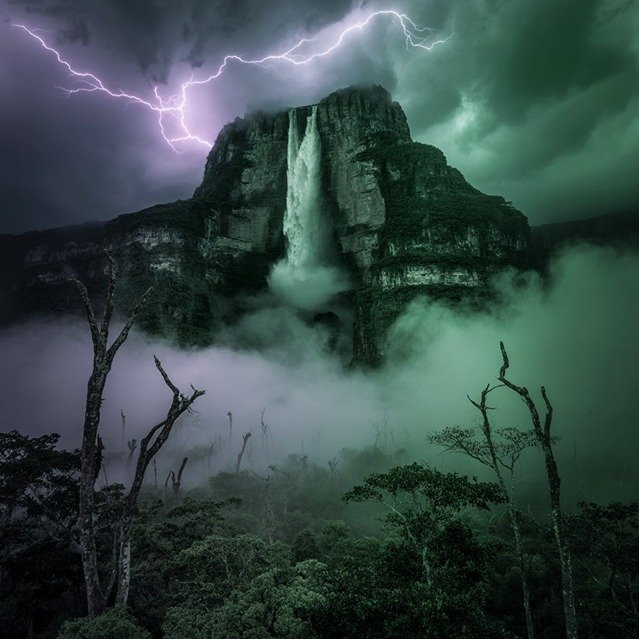
The defining event took place on October 9, 1937, when Angel attempted to land his aircraft on the summit of Auyán-tepui. His wife, Marie, Venezuelan engineer Gustavo Heny, and another companion were also on board. The landing was only partially successful. The soft, marshy ground caused the aircraft’s wheels to sink, leaving the plane badly damaged and unable to take off again.
The group found themselves stranded on top of an isolated table mountain, far from any conventional route to safety. With no practical way to repair the aircraft or arrange an immediate rescue, they eventually began a dangerous descent on foot.
The journey took 11 days. They had to navigate steep, unfamiliar terrain, dense vegetation, and difficult conditions with limited supplies before finally reaching the settlement of Canaima. All of them survived, and the extraordinary story attracted international attention.
Angel’s aircraft remained on top of Auyán-tepui for 33 years. In 1970, it was dismantled and removed by helicopter in a complicated operation. The restored aircraft was later displayed at the airport in Ciudad Bolívar.
Jimmie Angel died in 1956, but his connection to the waterfall did not end there. On July 2, 1960, his wife and sons fulfilled his wish by scattering his ashes over Angel Falls. In a sense, the adventurous pilot became part of the landscape that had made him famous.

How Tall Is Angel Falls? Measuring the World’s Highest Waterfall
The height of Angel Falls was officially established following a 1949 expedition led by American journalist and photographer Ruth Robertson. Her team traveled to the falls, photographed them from the ground and carried out measurements that helped establish their extraordinary scale. The expedition was later documented in National Geographic, bringing the waterfall to an even wider international audience.
The commonly cited total height is 979 meters (3,212 feet), while the longest uninterrupted drop measures approximately 807 meters (2,648 feet). To put that into perspective, the total height is roughly 19 times that of Niagara Falls.
However, there is an important distinction when discussing whether Angel Falls is actually the tallest waterfall in the world. Waterfall measurements can be complicated. Some rankings consider the total vertical height of a waterfall, including several separate drops, while others focus on the longest uninterrupted plunge. This distinction has sparked debate over the title, particularly when compared with Tugela Falls in South Africa.
Angel Falls holds the record for the world’s highest uninterrupted waterfall drop. Its total height of 979 meters is also widely quoted as the world’s highest waterfall measurement, although some waterfall researchers argue that Tugela Falls may have a greater combined height when all its separate tiers are counted. For this article, we’ll use the widely recognized Angel Falls measurements while keeping that distinction in mind.
One of the most remarkable effects of its enormous height is what happens to the water as it falls. For much of the year, the water does not reach the ground as a continuous stream. Instead, it breaks apart into fine droplets and mist during the long descent, creating the appearance of a white cloud rising from the jungle below.
Visitors standing near the base may not even be able to see the top of the waterfall. Its immense height, the surrounding cliffs, and the persistent mist can make the summit seem to disappear into the sky.

How Was Angel Falls Formed, and How Old Is It?
The geological story of Angel Falls is almost as impressive as the waterfall itself. The falls emerge from Auyán-tepui, one of the enormous tabletop mountains that dominate Canaima National Park. These formations are known as tepuis, and they are among the oldest geological landscapes in South America.
The underlying rocks in the region date back approximately 1.7 billion years. Over hundreds of millions of years, geological processes, erosion, and the movement of the Earth’s crust helped shape the landscape. A once much larger sandstone plateau gradually broke apart, leaving behind the isolated, flat-topped mountains that we see today.
The steep cliffs of Auyán-tepui provide the dramatic edge over which the water plunges. Rainfall collects on the summit and flows through the landscape before reaching the cliff edge, where it becomes Angel Falls.
There is no precise date for the waterfall’s formation, so we can’t know for sure how old Angel Falls is. The geological foundations of the landscape are incredibly ancient, but the waterfall is an ongoing natural feature shaped by erosion, rainfall, and changing environmental conditions. In other words, the rocks are ancient, while the waterfall continues to evolve.
How To Get To Angel Falls?
Visiting Angel Falls is one of the more challenging experiences in nature tourism. Although it is one of Venezuela’s best-known natural attractions, relatively few travelers make the journey to the waterfall itself.
This is not a destination you can reach by simply driving along a paved road. Angel Falls lies deep in a remote region of Venezuela, and reaching it requires careful planning, local expertise, and a willingness to deal with uncomfortable conditions.
The usual starting point is Canaima, a small settlement within the national park. Visitors generally reach it by domestic flight, with routes and connections depending on the tour operator and current flight schedules. Flights may be available from cities such as Ciudad Bolívar or Puerto Ordaz, while connections from Caracas can also be arranged depending on the season and available services.
From Canaima, the journey usually continues by river. Visitors travel in traditional motorized wooden canoes known as curiaras, navigating the waterways for several hours. The exact duration depends on river conditions, the route, and the water level.
The final part of the journey involves walking through dense rainforest to a viewpoint near the base of the waterfall. The trail can be muddy, slippery, and physically demanding, particularly after heavy rain.
Many organized excursions take two or three days, sometimes including an overnight stay in a simple riverside camp. The experience differs from a conventional sightseeing trip: accommodation may involve hammocks under a sheltered structure, and the journey depends heavily on the weather and river conditions.
When Is the Best Time to Visit Angel Falls?
The best time to visit depends on what you want to experience.
The rainy season generally runs from around May or June through November or December. During this period, rivers tend to have higher water levels, making boat journeys to the waterfall more feasible. The waterfall itself is also usually more impressive, with a greater volume of water flowing over the cliff. However, there is a trade-off. Heavy rain and cloud cover can make visibility unpredictable. The summit may be hidden behind clouds, and river conditions can sometimes make the journey more difficult.
During the dry season, generally from December to April or May, river levels fall, and the waterfall may carry considerably less water. On the other hand, clearer skies can offer better opportunities for aerial views of the falls.
This means that there is no perfect time for every visitor. If your priority is seeing the waterfall at its fullest, the rainy season is generally preferable. If you want clearer skies and an aerial view, the drier months may offer advantages.
Christmas at Angel Falls: Is December a Good Time to Visit?
If you’re thinking about spending Christmas near Angel Falls, December can be an interesting but unpredictable time to plan a visit.
It is generally a transition period between the rainy and dry seasons. Depending on recent rainfall, the rivers may still be navigable, but water levels can begin to fall. This means that some river excursions may be possible while others may be restricted or unavailable.
There is no major Christmas attraction or special holiday tradition at the waterfall itself. The appeal of visiting around Christmas is mainly the opportunity to experience the surrounding rainforest and the dramatic landscape during this seasonal transition.
If you are considering a December trip, check with local tour operators before booking flights or accommodation. The availability of river excursions depends on actual water levels, not simply the date on the calendar.
Can You See Angel Falls from the Air?
Yes. Aerial flights are one of the most spectacular ways to experience Angel Falls, especially when river levels are too low for a boat journey to the base.
Small aircraft can fly over Canaima National Park and around Auyán-tepui, offering a bird’s-eye view of the waterfall and the surrounding jungle. The experience depends heavily on weather conditions, and flights may be canceled or adjusted if clouds and visibility make the route unsafe. However, an aerial view of Angel Falls may be worth the journey.
The view from above also helps put the waterfall’s scale into perspective. From the ground, it can be difficult to appreciate just how far the water travels before reaching the jungle below.
Is It Worth the Effort?
The journey to Angel Falls is demanding and not suitable for everyone. It requires more time and preparation than visiting many of the world’s better-known waterfalls.
Considering the difficult access, the unpredictable weather, and the physical demands of the trip, it is understandable that some travelers exploring South America choose to visit waterfalls that are easier to reach, such as Niagara Falls or Iguazú Falls. But for those willing to make the journey, Angel Falls offers an experience that is difficult to compare with anything else.
Angel Falls in Popular Culture
Angel Falls has inspired filmmakers and storytellers for decades, largely because of its dramatic appearance and almost otherworldly surroundings. Its landscape has appeared in several films, either directly or as inspiration for fictional locations.
One of the best-known examples is Pixar’s animated film “Up” (2009). The movie’s fictional Paradise Falls was inspired by Angel Falls and Venezuela’s spectacular tepui landscape.
The film follows an elderly widower, a young Wilderness Explorer, a talking dog and an exotic bird on an extraordinary adventure. Using a house lifted by thousands of balloons, the characters travel to Paradise Falls to fulfill a promise made to the man’s late wife.
“Up” became a major international success, earning more than $730 million worldwide. It also won two Academy Awards, including Best Animated Feature and Best Original Score, and received a Best Picture nomination.
Another film connected to the waterfall is the fantasy drama “What Dreams May Come” (1998), starring Robin Williams, Cuba Gooding Jr., Max von Sydow, and Annabella Sciorra.
The film follows a man who dies in a car accident and finds himself in a version of the afterlife. When he discovers that his wife has died by suicide and is trapped in a state of despair, he embarks on a dangerous journey to find and save her.
The film features several spectacular landscapes, including Angel Falls, which helps create its dreamlike vision of paradise. Although it received mixed reactions at the box office, it became particularly memorable for its visual style and imaginative portrayal of the afterlife.
Angel Falls also provided a dramatic backdrop for the 2015 remake of “Point Break”. The film stars Edgar Ramírez and Luke Bracey as characters involved in a series of extreme sports challenges and daring criminal exploits.
One of its most spectacular sequences features climbers scaling the cliffs near the waterfall before making an apparently impossible leap. The scene is part of a film packed with extreme stunts involving skiing, surfing, motorcycles, parachutes, and climbing.
It may not be the most convincing action film ever made, and some of its stunts stretch credibility, but fans of spectacular action sequences may still find plenty to enjoy.
And now, finally, we arrive in horror territory.
One of the films that gave an entire generation a fear of spiders is “Arachnophobia” (1990), produced by Steven Spielberg and directed by Frank Marshall. The film is a classic creature feature, combining suspense, dark humor and one of nature’s most effective horror ingredients: spiders.
The story begins with an expedition to Venezuela, where a dangerous species of spider is discovered in the rainforest. One of the film’s key geographical references is the Canaima region, linking its deadly fictional creature to the same remote landscape surrounding Angel Falls.
So, on your next trip to South America, you may decide that Angel Falls is a little too remote, too difficult to reach or simply too intimidating. You might prefer to visit a more accessible attraction that is no less impressive, such as Iguazú Falls on the border between Brazil and Argentina.
And if you’re specifically looking for creepy and dangerous places on the continent, you may also want to read about attractions such as Bolivia’s Death Road.
Still, anyone who enjoys their natural wonders spectacular, remote, and a little frightening should know about Angel Falls: one of the most extraordinary waterfalls on the planet.